Why Choose an Eddy Current Separator?
Recycling plants face a practical challenge: recovering valuable non-ferrous metals from mixed material. An Eddy Current Separator uses a rapidly changing magnetic field to induce currents in conductive metals, then propels them away from non-conductive material. On a conveyor, that can mean separating aluminum cans or fragments from glass, plastic, and residue. The detail matters. Feed size, moisture, belt speed, and metal concentration can all affect separation quality.
The Global E-waste Monitor 2024 reports that the world generated 62 million tonnes of electronic waste in 2022, while only 22.3% was documented as formally collected and recycled. That figure describes e-waste, not all recyclable material, but it underscores the scale of the recovery challenge. The International Aluminium Institute reports that recycling aluminum uses about 5% of the energy required for primary production. Better metal recovery can therefore support resource efficiency, provided the material is clean enough for downstream processing.
Still, no separator sorts every mixed stream perfectly. That point is easy to overlook. Performance depends on the material and the full processing line, not just the machine. Buyers should compare verified throughput, recovery data, maintenance needs, and test results from representative feedstock. A short trial can reveal more than a polished brochure. Choose an Eddy Current Separator when measurable non-ferrous recovery fits the plant’s material, operating conditions, and business case.
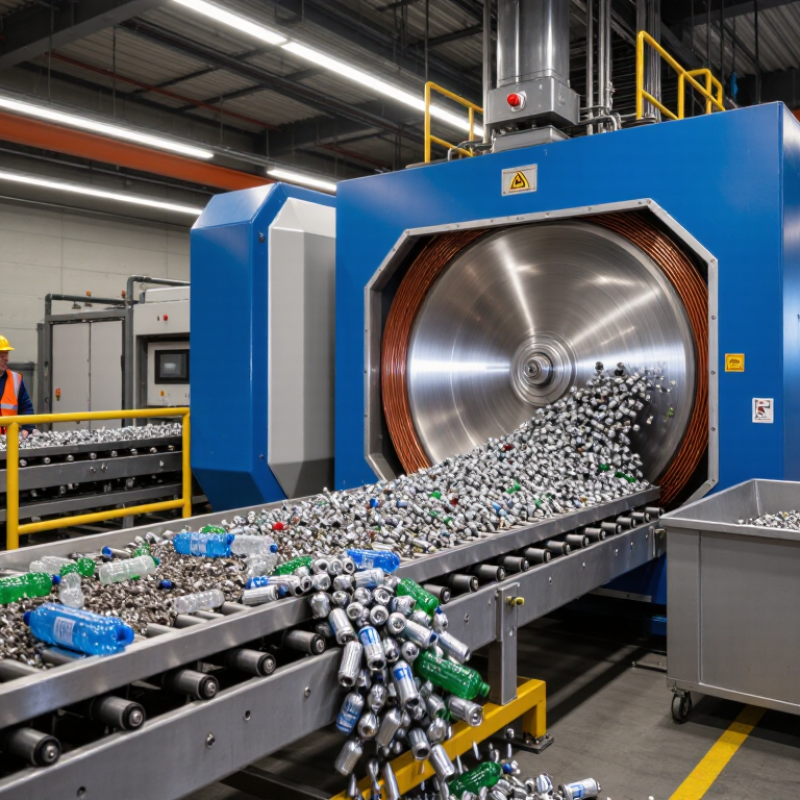
What an Eddy Current Separator Does: Repulsion Separates Nonferrous Metals
Why Choose an Eddy Current Separator?
What an Eddy Current Separator Does: Repulsion Separates Nonferrous Metals
An eddy current separator uses a rapidly rotating magnetic rotor beneath a conveyor belt. As conductive nonferrous pieces pass over it, the changing magnetic field induces currents in the metal. Those currents create a magnetic field that opposes the rotor’s field, pushing the pieces away from the belt’s normal path. Aluminum cans may jump forward, while glass and many other nonconductive materials continue to fall. The separator responds to conductivity and particle movement; it does not identify each metal by name. That distinction matters when designing a sorting line.
Performance depends on more than rotor speed. Particle size, belt speed, material depth, and moisture can all affect the separation. A crumpled can and a thin aluminum fragment may travel differently. Even well-adjusted equipment can send borderline pieces into the wrong stream. It is worth testing representative material and checking the output regularly, rather than assuming one setting will suit every batch.
Tips: Keep the feed spread in a shallow, even layer. Remove ferrous items upstream, and inspect the belt and splitter position during routine checks. A small adjustment can change where light fragments land. Test it.
How It Works: High-Speed Rotors Commonly Run at 2,000–4,000 rpm
Why Choose an Eddy Current Separator?
How It Works: High-Speed Rotors Commonly Run at 2,000–4,000 rpm
Inside an eddy current separator, a rapidly spinning magnetic rotor changes the magnetic field near conductive materials. This induces electrical currents in metals such as aluminium. The interaction creates a repelling force, helping eject metal from a moving stream of mixed material. Rotors commonly operate at 2,000–4,000 rpm, but speed alone does not determine performance. Rotor diameter matters too: a 300 mm rotor turning at 3,000 rpm has a rim speed of about 47 metres per second. That is fast. Feed depth, particle size, belt speed, and material condition all affect separation, so a single setting rarely suits every line.
The practical value is clearer when recovered aluminium stays clean enough for recycling. The International Aluminium Institute’s report, Aluminium Recycling: A Cornerstone of Sustainable Development, states that recycling aluminium uses about 95% less energy than producing primary aluminium. That figure explains why reliable recovery matters, though it is not a guarantee of savings at every facility. Operators should check separation results with representative material, not just a clean test sample. Fine particles can behave differently. And worn belts or uneven feed can weaken results. It is easy to blame rotor speed; sometimes the real issue sits upstream.
What It Recovers: Aluminum, Copper, and Brass from Mixed Material Streams
An eddy current separator can recover nonferrous metals from mixed material streams by using a changing magnetic field to propel conductive pieces away from nonconductive material. Aluminum cans, copper fragments, and brass fittings may enter the recovered fraction. Results depend on particle size, shape, and feed conditions. Small flakes behave differently. That matters.
The separator does not automatically produce three clean metal grades. It typically concentrates nonferrous material; additional sensor sorting or quality checks may be needed to distinguish aluminum from copper and brass. Thin foil, tangled wire, and wet fines can affect separation. The line is rarely perfect. Testing the actual feedstock and checking both recovered material and rejects helps operators adjust belt speed and rotor settings.
The value of recovery is substantial, but depends on clean output.
The International Aluminium Institute reports that recycling aluminum uses about 5% of the energy required for primary production.
The International Copper Association reports energy savings of up to 85% for recycled copper compared with primary production.
These industry figures describe material-level benefits, not guaranteed savings from any single separator.
A practical question remains: how much saleable metal does the line recover after sorting losses?
Feed Size Matters: Many Systems Handle Particles Above 2–5 mm
Why Choose an Eddy Current Separator?
Feed Size Matters: Many Systems Handle Particles Above 2–5 mm
An eddy current separator can recover non-ferrous metals from mixed material, but particle size sets a practical limit. Many systems are designed for pieces above roughly 2–5 mm. Finer particles may follow the belt, cling to other material, or receive too little force for reliable ejection. Small pieces behave differently. Actual performance depends on rotor speed, belt settings, particle shape, and how evenly material spreads across the belt.
That threshold is a guide, not a promise. A crushed aluminum fragment may separate cleanly, while a thin, curled piece of similar size may not. Test representative feed before choosing equipment; I would not trust a size specification alone. The value of recovery is substantial: European Aluminium’s 2020 recycling report says recycled aluminum requires about 5% of the energy used for primary production. Yet the U.S. EPA reported a 50.4% recycling rate for aluminum cans in 2018. Those figures concern different stages of recycling, but they underline why missed metal matters. Screen out excessive fines, keep the feed layer shallow, and check the recovered fraction for metal left behind. A simple test can reveal more than a brochure.
Why Choose an Eddy Current Separator? - Feed Size Matters: Many Systems Handle Particles Above 2–5 mm
| Feed condition | Typical particle size | Suitability for eddy current separation | Practical consideration |
| Coarse, free-flowing material | Above 20 mm | Often suitable for conventional systems when non-ferrous particles are liberated from other materials. | Keep the feed layer even and avoid overloading the belt so particles can separate cleanly. |
| Medium-sized material | 5–20 mm | Commonly within the working range of many eddy current separators. | Consistent particle size and presentation help produce more predictable trajectories. |
| Fine fraction | 2–5 mm | Can be processed by systems configured for fine particles; performance depends on separator design and feed properties. | Screening and careful adjustment of belt speed and splitter position may be important. |
| Very fine material | Below about 2 mm | Often challenging for standard units; dedicated fine-particle equipment or another recovery method may be needed. | Fine particles are more affected by material interactions, feed presentation, and moisture-related agglomeration. |
| Broad or mixed size distribution | Multiple size ranges in one feed | May be separable, but results can vary across particle sizes. | Screening into narrower size fractions can help match each fraction to suitable operating conditions. |
| Wet, sticky, or agglomerated feed | Any size | Unfavorable if particles do not feed and travel individually. | Drying or conditioning the material can reduce clumping and improve consistent presentation. |
| Feed containing ferrous pieces | Any size | Eddy current separators target electrically conductive non-ferrous metals, not ferrous metals. | A magnetic separation step is commonly used upstream to remove ferrous material. |
Note: The 2–5 mm range is a general reference, not a universal cutoff. The practical minimum depends on separator configuration, material type, particle shape, feed rate, and test results.
How to Choose One: Match Rotor Speed, Belt Speed, and Particle Size
Choosing an eddy current separator means matching rotor speed, belt speed, and particle size to the actual feed—not just maximizing throughput. A faster rotor creates more frequent magnetic-field changes, which can improve ejection of small, conductive pieces. But excessive speed may scatter light fragments or throw mixed particles unpredictably. Belt speed controls exposure time: a fast belt may carry pieces past the rotor before they separate. A slow belt helps, but cuts capacity. There is no universal setting.
Particle size matters because fine pieces respond differently from bulky ones. Test a representative sample, including dusty fines and flattened fragments, then adjust rotor speed while keeping belt speed steady. Watch where each fraction lands. Change one setting at a time. Small trials are revealing. The International Aluminium Institute reports that recycled aluminium uses about 5% of the energy required for primary production, making effective recovery valuable. That figure describes aluminium production, not separator performance. A clean test feed may also flatter results; real material is messier, and I would not trust a setting until it works on the usual feed mix.
Why Choose an Eddy Current Separator?
Match rotor speed, belt speed, and particle size
Smaller particles often need a slower belt to allow effective separation; rotor speed also affects the ejection force. The values shown are illustrative setup examples, not measured performance or universal recommendations. Actual settings depend on rotor design, material, and feed conditions.

 More