How to Choose the Right Control Valve for Your System?
Choosing the right control valve for your system is crucial. Dale Roberts, a renowned expert in fluid dynamics, once said, "The heart of any piping system lies in its control valves." This emphasizes the importance of these components. Control valves affect process efficiency and product quality.
Understanding your needs is essential. Consider factors like flow rate, pressure, and temperature. Each system has unique requirements. A mismatch can lead to problems. If the control valve isn’t suited for its tasks, failures might occur. It's a situation that requires careful thought.
Choosing a control valve is not just a technical decision. It's a balance between specifications and practical benefits. Experts often remind us to reflect on past choices. Sometimes, even the best plans can go awry. Selecting the proper control valve requires both knowledge and intuition.
Understanding Control Valves and Their Applications
Control valves are essential components in various systems. They manage fluid flow, pressure, and temperature. Different applications require different types of valves. Choosing the right one can be challenging.
Consider the specific needs of your system. The flow rate and pressure must be analyzed carefully. A simple butterfly valve might work for low-pressure applications. However, more precise systems often need globe or ball valves. Each option has its advantages and disadvantages.
Also, think about the size of the valve. An oversized valve can lead to inefficiencies. It may cause problems like excessive wear or energy loss. On the other hand, a valve that is too small may not handle the required flow. Sometimes, trial and error is necessary. It can take time to find the perfect match for your application. Remember, the right control valve can significantly enhance system performance.
Key Factors to Consider When Selecting Control Valves
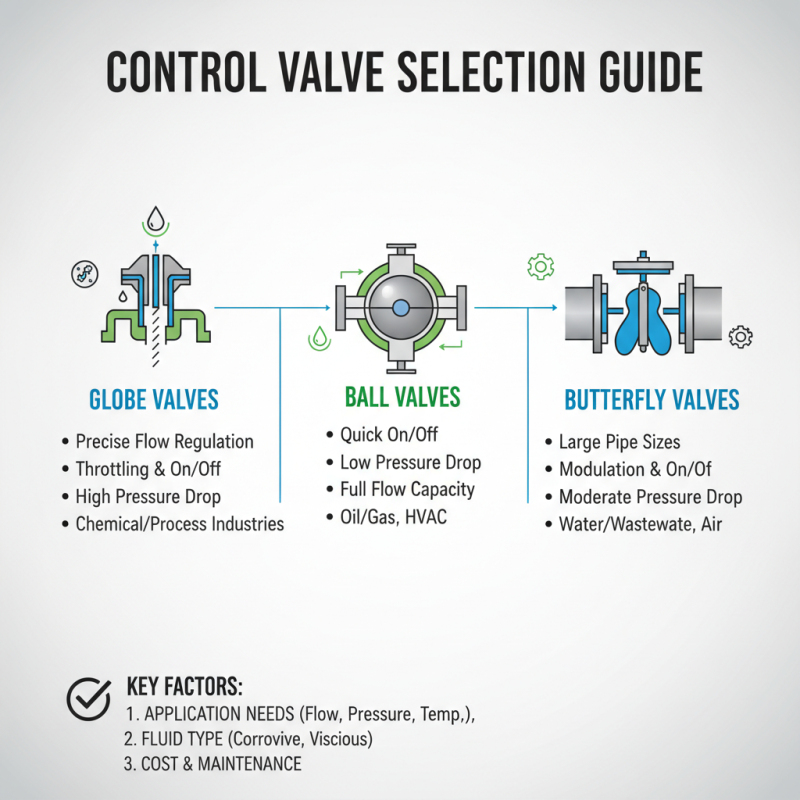
Choosing the right control valve for your system requires careful consideration of several key factors. One major factor is the valve type, which can vary significantly. There are globe valves, ball valves, and butterfly valves, each serving different applications. Understanding what each type does is essential. The wrong choice can lead to inefficiencies.
Another crucial aspect is the flow characteristics. You need to know how much fluid your system requires. Different valves control flow differently. Some might offer good throttling, while others provide on/off control. These characteristics affect performance and energy efficiency. It’s not just about picking a valve; it’s about ensuring it fits your unique needs.
Material selection also plays a significant role. Valves made of different materials withstand varying pressures and temperatures. You must match the valve materials to your system’s operating conditions. Failure to do so can lead to premature failure. Reflecting on these choices is vital for long-term success.
Types of Control Valves and Their Specific Uses
Choosing the right control valve can be daunting. Each type serves a specific purpose. For instance, globe valves are great for throttling. They provide precise control over flow. These valves are often used in heating systems. They can handle high-pressure drops.
Ball valves offer quick shut-off capabilities. They are efficient and durable. These are often used in gas and water systems. On the other hand, butterfly valves are lighter and more compact. They work well in larger pipelines. However, they can be less precise than other types.
Check valves prevent backflow in systems. They are essential for maintaining flow direction. Pressure relief valves ensure safety by releasing excess pressure. While these types serve specific uses, the selection can be tricky. It’s crucial to assess system needs carefully. Improper choices can lead to inefficiencies and costly repairs. Reflecting on your needs is vital for success.
Types of Control Valves and Their Applications
This chart illustrates the different types of control valves and their applications in industrial systems. Each type of valve is shown alongside its percentage of usage in various scenarios.
Evaluating Material and Sizing Considerations for Control Valves
Choosing the right control valve for your system involves several material and sizing considerations. The material of the valve must withstand the operating conditions. For instance, high-temperature applications require materials like stainless steel. However, not all steel is the same. Corrosive environments may necessitate more specialized alloys. This approach can be expensive, prompting a careful cost-benefit analysis.
Sizing also plays a critical role in valve performance. An oversized valve can result in poor flow control, while an undersized one may restrict flow too much. The flow coefficient (Cv) is essential for accurate sizing. It's important to consider factors like pressure drop and fluid characteristics. Many overlook these details, leading to operational inefficiencies. Constantly reassessing these factors helps ensure the valve meets system requirements effectively. A valve too close to maximum capacity demands can become a liability. Balancing capability and actual needs might not be straightforward, and revisiting specifications is often necessary.
Installation and Maintenance Best Practices for Control Valves
When it comes to control valves, proper installation and maintenance are crucial for
optimal performance. According to a report by the International Society of Automation (ISA),
nearly 30% of control valve failures can be traced back to improper installation.
It’s essential to ensure that the valve is fitted correctly with proper alignment
and using compatible materials. Any oversight here can lead to leaks or blockages.
Regular maintenance should not be overlooked. A study by the Control Valve Research Institute
indicates that 50% of valves in industrial applications show signs of wear due to lack of maintenance.
Simple actions, like regular visual inspections and lubrication, can significantly extend the life of valves.
Neglecting to track performance data may result in undetected
issues, leading to costly downtime later.
Involving field technicians during installation can improve understanding of unique system requirements.
They can provide insights that might not be apparent in standard procedures.
It's easy to assume that all valves behave similarly,
but each situation requires careful evaluation. Investing time in upfront planning may prevent future headaches.
Checking flow rates and ensuring the correct size can save significant time and resources.

 More
More